





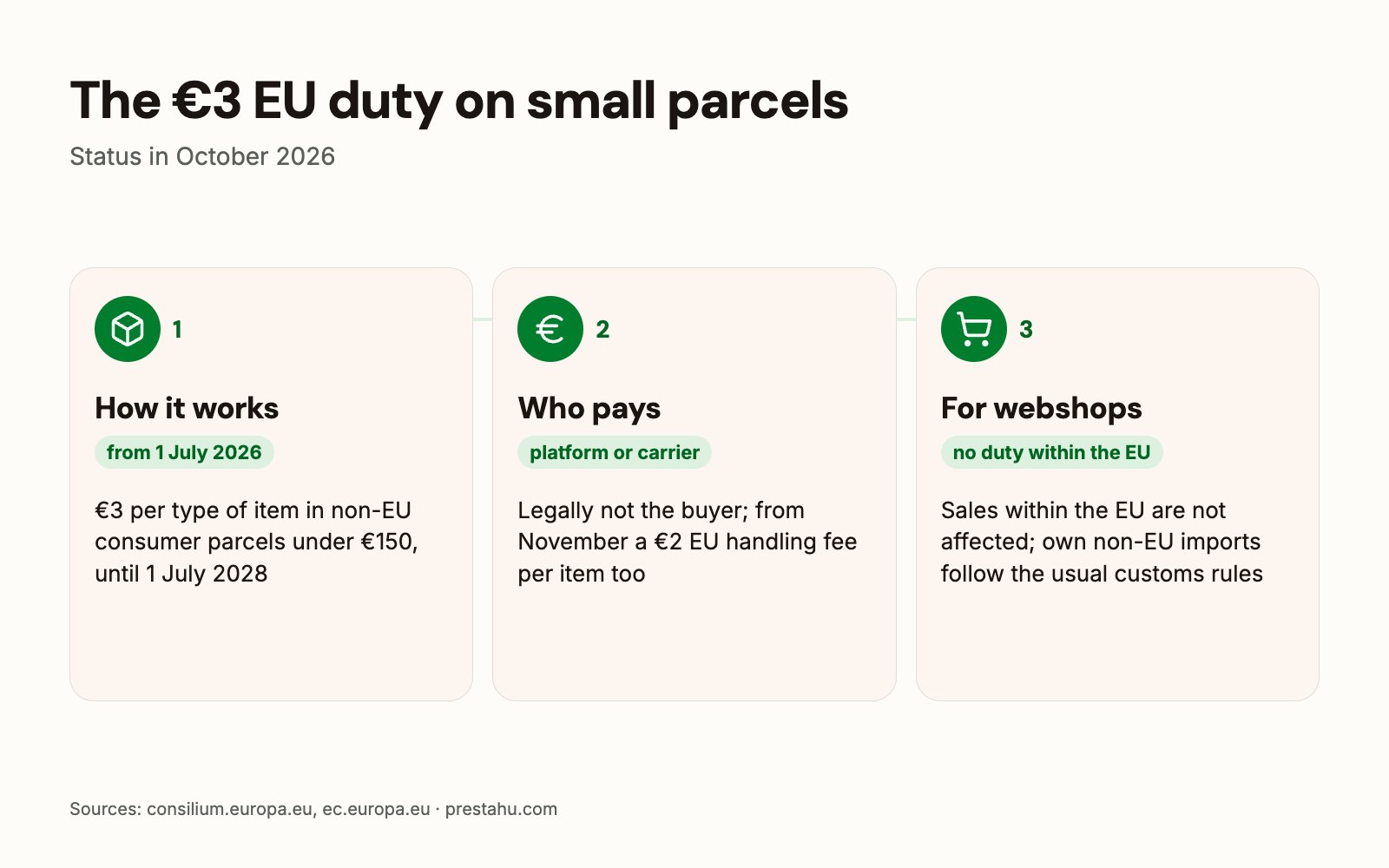
Since 1 July 2026, parcels worth less than €150 from webshops outside the EU are subject to customs duty: €3 per type of item. Until then only VAT was due on them, no customs duty. According to the Commission, 91% of such small parcels came from China in 2024. From 1 November 2026, a €2 EU handling fee per item comes on top.
This article sums up how the €3 duty works, who pays it, what the first figures show, what the EU has done about Temu and Shein, and what it all means for a webshop in the EU.
Not a technical person?In plain English: do I need to do anything now?
The €3 duty applies to parcels sent to private customers from outside the EU. If the shop sells from stock within the EU, its sales are not affected: no customs duty is due on them, just as before.
Parcels from non-EU platforms now carry the duty, but goods that platforms ship from EU warehouses do not, and buyers can also turn to other marketplaces. So it is worth making the shipping cost, the total price and the delivery time visible early in the purchase.
If the shop itself orders goods or samples from outside the EU in small parcels, other rules may apply. The question below can be sent to the accountant or customs agent as it is.
Question for the accountant or customs agent
The shop also orders goods, samples or parts from webshops outside the EU, in parcels worth less than €150, as a business with a VAT number. Which customs duty and VAT apply to these since 1 July 2026, and does the €2 EU handling fee from 1 November 2026 apply to us?
How does the €3 customs duty work?
The rule was introduced by Council Regulation (EU) 2026/382, adopted on 11 February 2026. It removed the €150 customs duty exemption and replaces it with a temporary flat duty from 1 July 2026 to 1 July 2028.
- Per type of item, not per parcel: in the Commission's example, 5 T-shirts cost €3, 1 T-shirt and 1 watch €6. The type is set by the tariff classification, not the quantity.
- Only under €150: for more expensive consignments the usual customs rules apply.
- For consumer parcels: according to the Commission, all goods up to €150 sold in distance sales (to private customers), whatever the VAT scheme.
- Temporary: from 1 July 2028, when the EU customs data hub is expected to start, the standard customs tariff applies by value, origin and type of product; depending on the product this may be more or less than €3.
| From | What is due | How much |
|---|---|---|
| 1 July 2021 | VAT on all imports | at the VAT rate |
| 1 July 2026 | flat duty under €150 | €3 per type of item |
| 1 November 2026 | EU handling fee | €2 per item line |
| 1 July 2028 | standard customs tariff | by value and product |
The €2 handling fee is not temporary and also applies to parcels above €150 if the goods were sold to a private customer. Member States have to stop their own national handling fees at the latest when the EU fee starts.
Who pays the €3?
According to the Commission, legally not the buyer: the duty is paid by the non-EU platform, the seller, or the carrier or agent declaring the goods to customs, and it is not collected from the buyer at delivery. Whether the platform passes it on in the price is up to the platform.
The revenue is split: 75% goes to the EU budget, 25% stays with the Member State.
What do the first figures show?
There is no official EU-wide figure yet on parcel volumes since July. According to Euronews, the French economy ministry, citing French customs figures, spoke of a 30–40% drop in small parcels imported into the EU since the duty started. Two national examples:
- Hungary: the tax and customs authority (NAV) handled about 22 million consignments between July and September, 245,000 a day on average, and says the number of small parcels from outside the EU has fallen since July.
- Romania: since 1 January 2026 a national logistics fee of 25 lei per parcel applies to non-EU parcels under €150; the €3 EU duty has come on top of it since July.
Why did the EU introduce it?
According to the Commission, 4.6 billion such small parcels entered the EU in 2024, 91% of them from China, and almost 5.9 billion low-value items in 2025, four times the 2022 volume. According to the regulation, the €150 exemption left the door open to undervaluing goods and splitting consignments. The Commission's aim is to level the playing field between parcels imported one by one and traditional retail, which imports in bulk and has always paid customs duty.
In the Commission's targeted checks in 2025 (cosmetics, toys, electronics and other products), over 60% of checked products failed EU standards.
What has the EU done about Temu and Shein?
- Temu: on 28 May 2026 the Commission fined Temu €200 million under the Digital Services Act (DSA) for failing to properly assess the risk of illegal products. In mystery shopping, a very high share of the chargers failed basic safety tests.
- Shein: on 17 February 2026 the Commission opened formal DSA proceedings (addictive design, transparency of recommender systems, illegal products); the network of national consumer protection authorities runs a coordinated action in parallel.
We found no statement from Temu or Shein on the €3 duty.
What does it mean for an EU webshop?
The €3 duty only applies to goods imported from outside the EU; sales within a country or to another EU country are not affected. Parcels from non-EU platforms now carry the duty; goods that platforms ship from warehouses inside the EU do not.
If the shop orders goods from outside the EU as a business with a VAT number, that is not a distance sale, so the €3 flat duty is not meant for it; according to the regulation, the Common Customs Tariff applies to such imports. The exact duty is set by the customs agent or the customs authority.
According to the Commission's guidance, the duty and the handling fee are also part of the taxable amount for import VAT.
What should you do now?
- Total price: show the shipping cost and the total on the product page or in the cart, not only at the last checkout step.
- Delivery time: show the expected delivery for products shipped from stock.
- Own imports: if the shop orders goods from outside the EU in small parcels, check with the accountant or customs agent which duty and fees apply.
- 1 November: the €2 handling fee applies to parcels sent from outside the EU to private customers, whatever their value.
Frequently asked questions
How much is the duty on a small parcel from outside the EU?
From 1 July 2026, in a parcel under €150, €3 per type of item: 5 T-shirts cost €3, 1 T-shirt and 1 watch €6. From 1 November a €2 handling fee per item comes on top.
Does the buyer pay the €3?
According to the Commission, legally the platform, the seller or the declaring carrier pays it, and it is not collected at delivery. Whether it is built into the price is up to the platform.
Is customs duty due on an EU webshop's sales?
No, if the shop ships from within the EU: the €3 duty only applies to goods imported from outside the EU.
How long does the €3 duty last?
Until 1 July 2028; after that the standard customs tariff applies by value and type of product. According to the regulation the period can be extended if the EU customs data hub is not ready by then.
Has the number of parcels from China fallen?
There is no official EU-wide figure yet. According to Euronews, the French economy ministry spoke of a 30–40% drop; the Hungarian customs authority also reports fewer small parcels from outside the EU since July.
Sources: Council of the EU, 12 December 2025, Council of the EU, 11 February 2026, Regulation (EU) 2026/382, European Commission: questions and answers, European Commission: guidance, EU customs reform, NAV (Hungary), 14 October 2026, Romania: Law 239/2025, Euronews, 27 August 2026, European Commission: Temu fine, European Commission: Shein proceedings


Comments
No comments yet.