



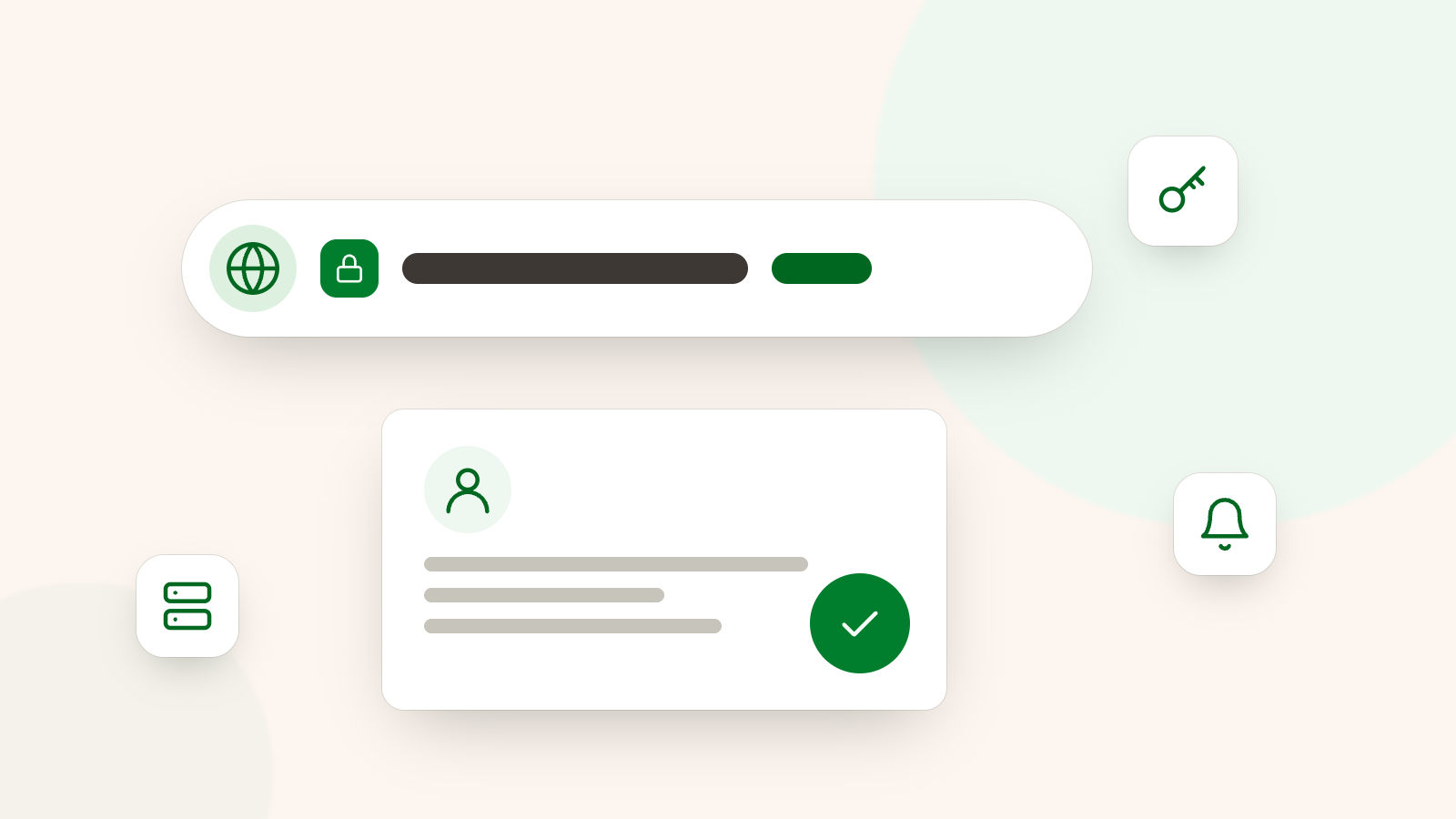
A domain is the address of a website or online shop on the internet, for example yourshop.com. It is what customers type into the browser, and it is also part of the email addresses. The first step of a new shop is a good, available address.
Buying a domain is not complicated, but a few things decide whether the address stays with the shop owner for the long term: whose name it is registered in, where it is registered, and who takes care of renewal. This article walks through how buying a domain works, step by step, using the rules of .com, the most widely used ending.
Not a technical person?In plain English: how do I get my own domain?
A domain is like an address: it is how people find the shop. You don’t buy it once; it has to be renewed from time to time, usually every year, otherwise it can be lost.
Domains are registered with a company authorised to do so. The most important thing is that the domain is registered in the name of the shop owner (a person or a company), not in the name of the agency that builds the shop or of an employee.
What to do: choose the name, check whether it is available, and register it in your own name with a provider. The questions below are worth asking the provider before paying.
Questions for the domain provider
Will the domain be registered in my (or my company’s) name as the registrant? What does registration cost, and what does renewal cost per year? Will I get a reminder before it expires, is there automatic renewal, and how can I transfer the domain to another provider?
What is a domain, and how is it different from hosting?
The domain is the address; the hosting is the place where the shop runs and its data is stored. They are separate services: they can be with the same company, but they don’t have to be. The hosting can later be changed while keeping the domain, and the domain can be moved to another provider without moving the shop.
The email address also depends on the domain (for example info@yourshop.com). If the domain lapses, both the shop and the email stop working.
How does buying a .com domain work?
You don’t buy a domain forever; you get the right to use it for a period. The parties involved:
- Registry: the .com registry is run by VeriSign. It records which domain belongs to whom.
- Registrar: the company where you register and pay for the domain. According to ICANN there are more than two thousand ICANN-accredited registrars, and they also have resellers.
- Registrant: the person or company that holds the rights to the domain.
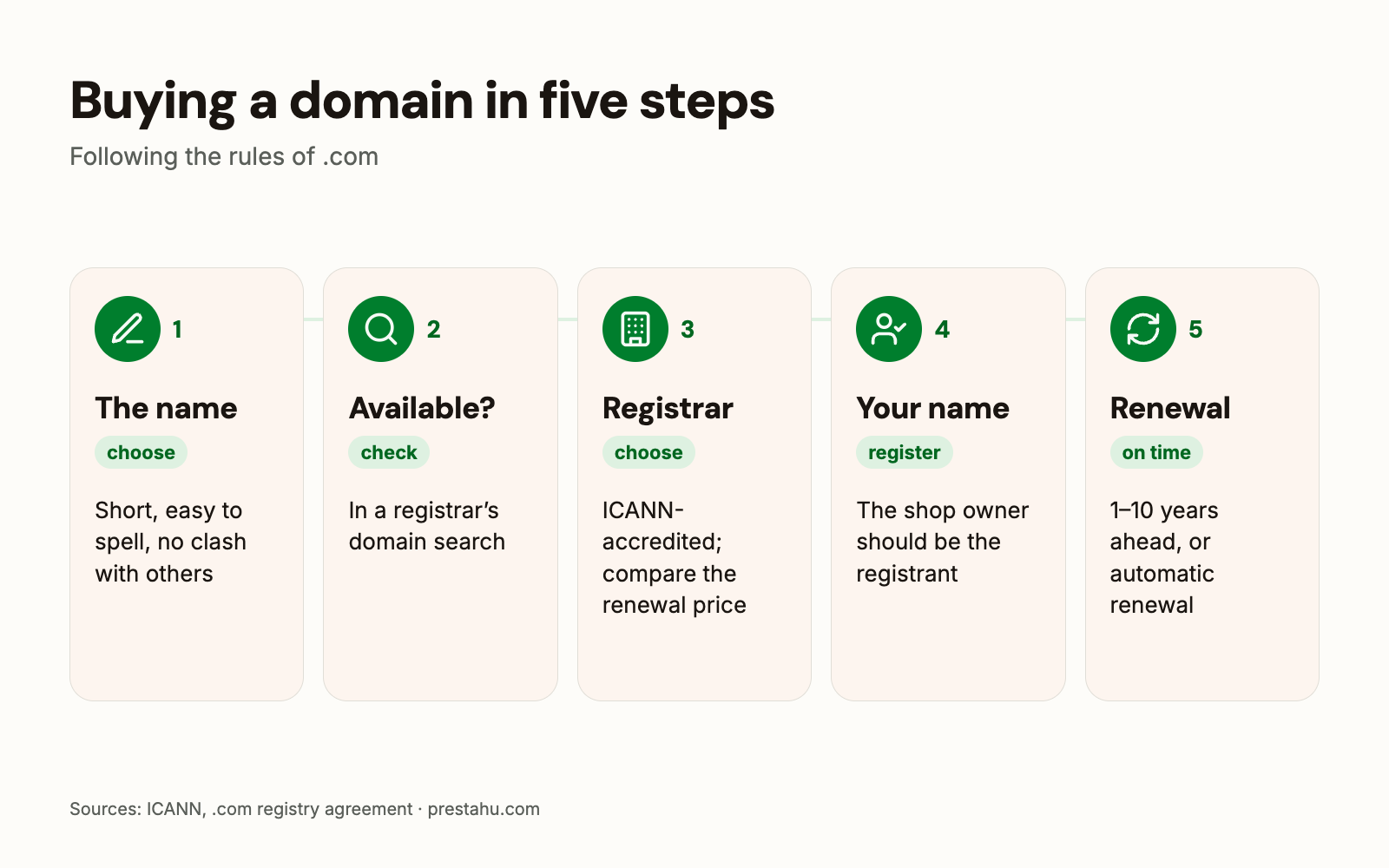
A registration typically runs for 1 to 10 years and can be paid that far in advance. After that it has to be renewed.
Country endings (for example .co.uk, .de, .hu or .ro) have their own registry and their own rules; it is worth reading them before registering such a domain.
What name is worth choosing?
- Short and easy to spell: something people can type after hearing it once.
- No clash with someone else’s name: check company and trademark registers before registering.
- Built for the long term: if the shop later adds new product lines, the name should still fit.
- The country ending too: if the shop sells in one country, the local ending (for example .co.uk or .de) may be worth registering as well.
Where is it worth registering a domain?
With any accredited registrar. Price is not the only factor; these are worth comparing:
- Whose name the domain is in: the registrant should be the shop owner. If an agency or developer registers it, it should still be in the owner’s name.
- The renewal price, not only the first year’s.
- Reminders before expiry and automatic renewal.
- Privacy: in the public registration data the registrant’s personal details are redacted where the law protects them; WHOIS has been replaced by RDAP since January 2025.
- Transfer to another provider: possible, but a registrar may refuse a transfer within 60 days of registration.
What happens when a domain expires?
Under ICANN’s rules the registrar sends reminders about one month and about one week before expiry, and another within five days after it. After expiry, a .com domain has a 30-day redemption grace period during which the registrant can still have it restored, for the fee the registrar publishes.
It is not worth waiting for this: arranging renewal in advance is simpler than getting a lost address back, and while the domain is not working, neither the shop nor the email is reachable.
How can a domain be moved?
- To another registrar: the registrant starts it; a registrar may refuse a transfer within 60 days of registration or of a previous transfer.
- To another owner: after a change of registrant, a 60-day transfer lock applies, which the registrant can opt out of.
What to do before buying a domain
- Write down 3–5 candidate names, short and easy to spell.
- Check whether they are available in a registrar’s domain search.
- Check company and trademark registers so the name does not clash with someone else’s.
- Choose a registrar by renewal price, reminders and transferability, and send them the questions from the “In plain English” box.
- Register it in your own name, with a real, active email address, because the expiry reminders go there.
- Turn on automatic renewal, or pay several years in advance, and note the expiry date.
A shop for your domain
PrestaShop shop development: design, catalogue, payment, couriers, invoicing, and updates after handover too.
If the platform for the shop is not decided yet: What is PrestaShop?
Frequently asked questions
How much does a .com domain cost?
The price is set by the registrar, so it differs from provider to provider. It is worth checking the renewal price too, not only the first year’s.
Can I buy a domain forever?
No. A .com domain is typically registered for 1 to 10 years and then has to be renewed. As long as it is paid for, it stays with the registrant.
Will my name and address be public?
Under ICANN’s registration data policy, the registrant’s personal details are redacted in the public data where the law protects them.
What if the agency that built the shop registered the domain?
Check who is listed as the registrant. If it is not the shop owner, the domain can be moved into the owner’s name with a change of registrant.
Sources: ICANN: domain name registration process, ICANN: renewal and expiration, ICANN: Expired Registration Recovery Policy, ICANN: Transfer Policy, ICANN: Registration Data Policy, .com registry agreement, ICANN: about domain names


Comments
No comments yet.