

PrestaShop is a program for building an online shop: it holds the products, the cart, payment, shipping and order management. It has existed since 2007, and according to its developer more than 230,000 shops run on it worldwide.
Anyone planning an online shop sooner or later chooses between two paths: renting a ready-made system for a monthly fee, or building their own shop with a program such as PrestaShop. This article explains, without technical knowledge, what PrestaShop is, what a PrestaShop shop is made of, what it costs and who it suits.
Not a technical person?In plain English: what is PrestaShop?
PrestaShop is the “engine” of an online shop: this program shows the products to customers, handles the cart and the orders, and it is also where the shop owner works. The program can be downloaded for free.
The program on its own is not yet a shop. It needs an address where people find it (a domain), a place where the program runs (hosting), a look and a few add-ons, for example for payment and couriers. Some of these cost money, and setting them up takes expertise.
In return the shop belongs to its owner: it can be moved elsewhere at any time and extended for almost any need. Anyone who wants a ready-made rented system they don’t have to look after may find a monthly shop service simpler.
Questions for the shop developer
Which PrestaShop version will the shop be built on? What do the hosting, the domain and the paid modules cost per year? Who updates the shop when a new version or a security fix comes out, and what does that cost?
What is PrestaShop, simply put?
PrestaShop is an open-source shop engine. Open source means the program’s code is public: anyone can download it, look at it and develop it further. The core of the program is released under the OSL-3.0 licence and the modules under AFL-3.0; these licences allow free use and modification.
In practice the shop is not inside a provider’s closed system but on the owner’s own hosting. The data of the products, customers and orders is there too, so the shop can be moved to another host, and any developer who knows PrestaShop can continue working on it.
- 2007 the year it started
- 230,000+ shops run on it (PrestaShop’s “About us” page)
- 75+ languages available
- 3,200+ themes and modules on the official marketplace
What is a PrestaShop shop made of?
An online shop is made of five parts. Compared to a physical shop:
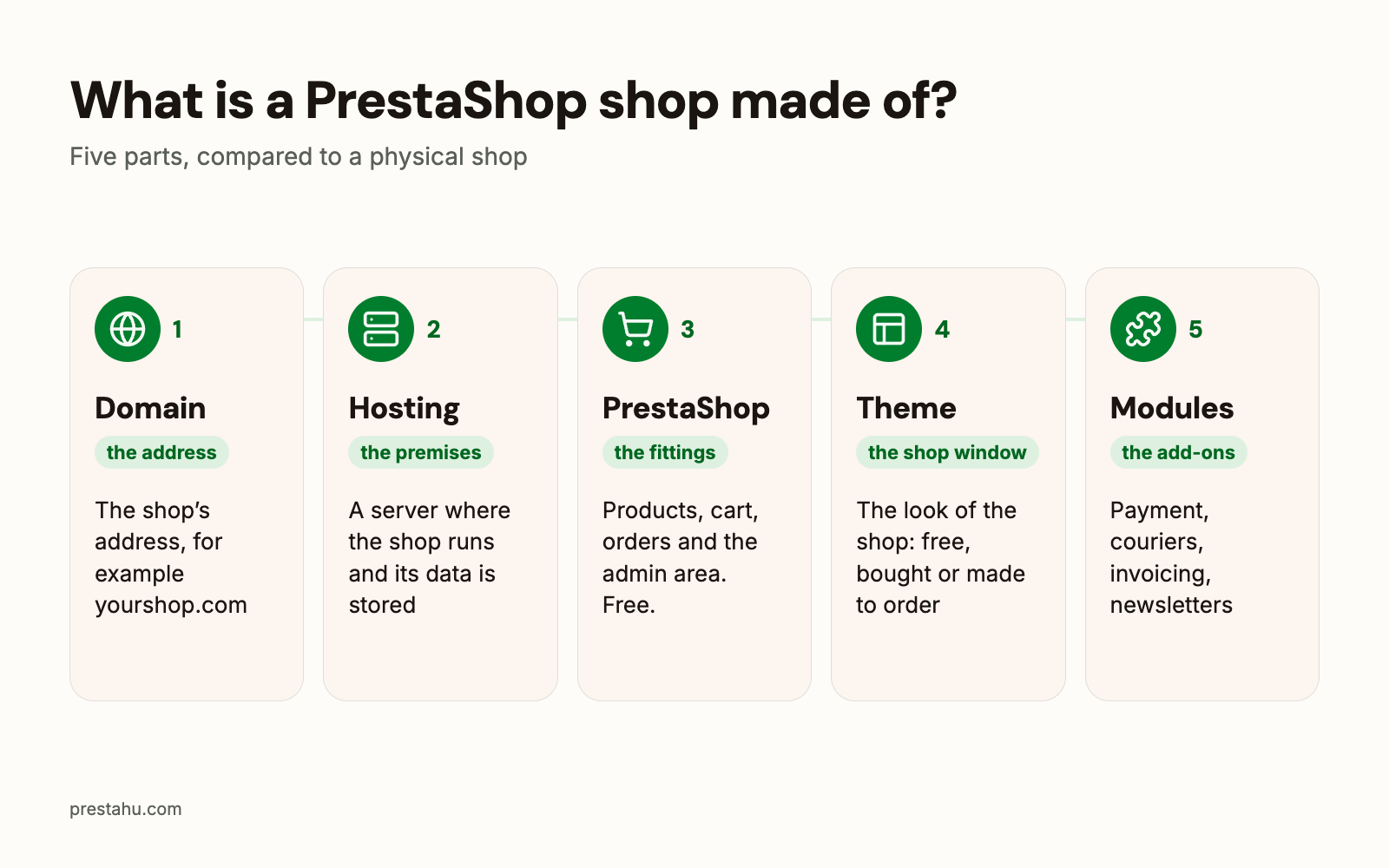
- Domain (the address): the shop’s address, for example yourshop.com. It has to be renewed periodically, usually every year. Step by step: How to buy a domain name.
- Hosting (the premises): a server where the shop runs and its data is stored. A service with a monthly or yearly fee.
- PrestaShop (the fittings): the program itself, with the products, the cart, the orders and the owner’s admin area. Free.
- Theme (the shop window): the look of the shop. There is a free default theme, and themes can also be bought or designed to order.
- Modules (the add-ons): extensions for a single task, for example online payment, couriers, invoicing or newsletters. Some are free, some are paid.
Is PrestaShop really free?
The program is: PrestaShop can be downloaded for free. The shop as a whole is not. PrestaShop’s own website states that hosting and the domain are not included, and that installing it takes technical knowledge.
The costs typically are:
- domain: usually a yearly fee;
- hosting: a monthly or yearly fee, depending on the size of the shop;
- theme and paid modules: a one-off fee or a yearly subscription;
- building the shop: setup, adding products, connecting payment and shipping;
- maintenance: updates, security fixes, backups.
There is also a monthly version: PrestaShop Hosted, run by PrestaShop itself. In October 2026 it starts at €24 a month (excluding VAT) and is based on PrestaShop 8. It replaces the hosting; setting up the shop and the modules is still the owner’s job.
How is it different from a rented shop?
With a rented (monthly) shop service the program belongs to the provider and the shop runs on their system. With PrestaShop the program runs on the owner’s hosting. The difference in short:
| Rented shop | PrestaShop shop | |
|---|---|---|
| Where it runs | on the provider’s system | on your own hosting |
| Monthly cost | a subscription, by the chosen plan | hosting + the fees of paid modules |
| Extending it | what the provider offers | almost anything with modules and custom development |
| Updates, security | done by the provider | done by the owner or a hired specialist |
| Moving it | as far as the provider’s export allows | the whole shop can be moved |
Neither is better in every case. A rented shop starts quickly and needs little care; PrestaShop pays off when the shop has specific needs, sells in several languages or countries, or the owner wants to build their own system for the long term.
What can PrestaShop do out of the box?
- Products and catalogue: categories, variants (for example size and colour), stock, sales, vouchers.
- Orders and customers: order management, invoices, customer accounts, customer groups with their own prices.
- Several languages and currencies: PrestaShop is multilingual out of the box, available in more than 75 languages, and handles several currencies.
- Several shops from one place: one installation can run several shops (multistore).
Our own example: prestahu.com, presta.hu and presta-shop.ro run from a single PrestaShop, in three languages and three currencies (euro, forint, leu), with shared customer and order data.
Which PrestaShop version is current?
The latest release is PrestaShop 9.2 (30 September 2026). PrestaShop 8.2 now only gets security and critical fixes, and maintenance of PrestaShop 1.7 ended in 2025, when 9.0 came out.
A new shop should therefore be built on PrestaShop 9. For an older shop the version also decides which PHP the shop runs on (PHP is the program on the hosting that runs PrestaShop), and with it whether it gets security fixes; this is covered in our article on the PHP security flaw.
Who is PrestaShop for?
- A good choice if the shop has specific needs (special products, custom pricing, a stock or invoicing system to connect), sells in several languages or countries, or the owner wants to build the shop as their own system for the long term.
- Think it over if nobody will do the updates and maintenance. PrestaShop does not update itself; the owner or a hired specialist has to take care of it.
- Less of a fit if the goal is a shop with a few products that starts quickly and that nobody wants to look after later. A rented shop service is simpler for that.
What to do if you are planning a PrestaShop shop
- Decide whether you need a rented or your own shop, using the points in the table above.
- Choose and register a domain before someone else takes it. Step by step: How to buy a domain name.
- Choose hosting that runs PrestaShop 9. PrestaShop 9.1 needs PHP 8.1–8.5; it is worth asking the hosting provider about this in writing.
- Build the shop on PrestaShop 9, not on an older version.
- Decide in advance who updates and backs up the shop, and what that costs per year. The questions in the “In plain English” box can be copied for this.
PrestaShop shop development
A shop on PrestaShop 9: design, catalogue, payment, couriers, invoicing, and updates after handover too.
Frequently asked questions
Is PrestaShop free?
The program can be downloaded for free. A shop also needs a domain, hosting, often a paid theme and modules, and the work of building and maintaining it, and these cost money.
Do I need to know programming to use PrestaShop?
Not for daily use: adding products, handling orders and running sales are done in the admin area. Installing it, setting up modules and updating it do take technical knowledge; PrestaShop’s own website says the same.
Can PrestaShop run in several languages?
Yes. Both the shop and the admin area are available in many languages, and one shop can run several languages at the same time.
What is the difference between PrestaShop and PrestaShop Hosted?
PrestaShop can be downloaded for free and runs on your own hosting. PrestaShop Hosted is a monthly subscription where PrestaShop provides the hosting; in October 2026 it starts at €24 a month (excluding VAT) and is based on PrestaShop 8.
Who is behind PrestaShop?
PrestaShop has existed since 2007. In 2021 it was bought by the MBE group, and today it belongs to the European tech group cyber_Folks. Besides the company, the open-source community also takes part in developing the program.
Sources: PrestaShop – About us, PrestaShop on GitHub and its licence, PrestaShop offers, PrestaShop Hosted, PrestaShop releases, PrestaShop 8.2 support, PrestaShop 1.7 support, PrestaShop 9 system requirements, MBE announcement (2021)


Comments
No comments yet.