

Article 50 of the EU Artificial Intelligence Act (AI Act) has applied since 2 August 2026. It requires that people who talk to an AI know about it, and that AI-generated images, audio or video that look deceptively real are labelled. In a webshop this mostly concerns the chatbot and AI-generated product images.
This article sums up who has to do what under the regulation, what the Commission's July 2026 guidelines say about product descriptions and product images, how high the fines are, who enforces the rules, and what PrestaShop 9.2's Ask AI assistant does.
Not a technical person?In plain English: do I need to do anything now?
If a machine answers customers in the shop (an AI chatbot), customers have to know, at the latest with the first message, that they are not talking to a person. The Commission lists chatbots embedded in online shops among those that are not an exception.
According to the Commission, product descriptions written with AI do not need a label, unless they contain claims about health, safety or the environment. AI-generated product images need a label if they show the product differently or better than it really is.
If a developer or an agency made the chatbot or the images, the question below can be sent to them as it is.
Question for the developer or agency
Article 50 of the AI Act has applied since 2 August 2026. Does our shop's chatbot tell visitors, at the latest with the first message, that they are talking to artificial intelligence? Does the shop have any AI-generated or AI-edited product images that show the product differently from what it really is?
What does Article 50 of the AI Act require?
Article 50 of Regulation (EU) 2024/1689 sets out transparency rules. The regulation separates two roles: the provider, who develops an AI system or has it developed and places it on the market or puts it into service under its own name, and the deployer, who uses the system under its own authority.
| What has to be done | Who is responsible | From |
|---|---|---|
| inform people they are talking to an AI (chatbot) | provider | 2 August 2026 |
| machine-readable marking of AI content | provider | 2 August 2026; older systems 2 December |
| disclose deep fake images, audio, video | deployer | 2 August 2026 |
| disclose AI text on matters of public interest | deployer | 2 August 2026 |
The information has to be given at the latest at the first interaction, in a clear and distinguishable way. The Commission's example is the start of a chatbot conversation; recommended forms are a label such as "You are interacting with an AI system", the chatbot's first message, or a badge visible throughout the conversation near the input field.
Regulation (EU) 2026/1744 (the Digital Omnibus), published in July 2026, only postponed the machine-readable marking to 2 December 2026, and only for providers of systems placed on the market before 2 August 2026. Chatbot disclosure and deep fake disclosure have been mandatory since 2 August.
What does this mean for a webshop chatbot?
According to the Commission's guidelines published on 20 July 2026, ecommerce and customer support chatbots fall under Article 50, and an AI chatbot embedded in an online shop does not fall under the "obviously AI" exception. The interaction is not direct if a customer service agent uses an AI tool and the agent answers the customer.
The text of the regulation puts chatbot disclosure on the provider. According to the Commission, a company that develops a chatbot in-house and puts it into service under its own name is also a provider. The guidelines give no explicit example of whether a shop using a purchased chatbot module is a provider or a deployer.
Do AI product descriptions and product images need a label?
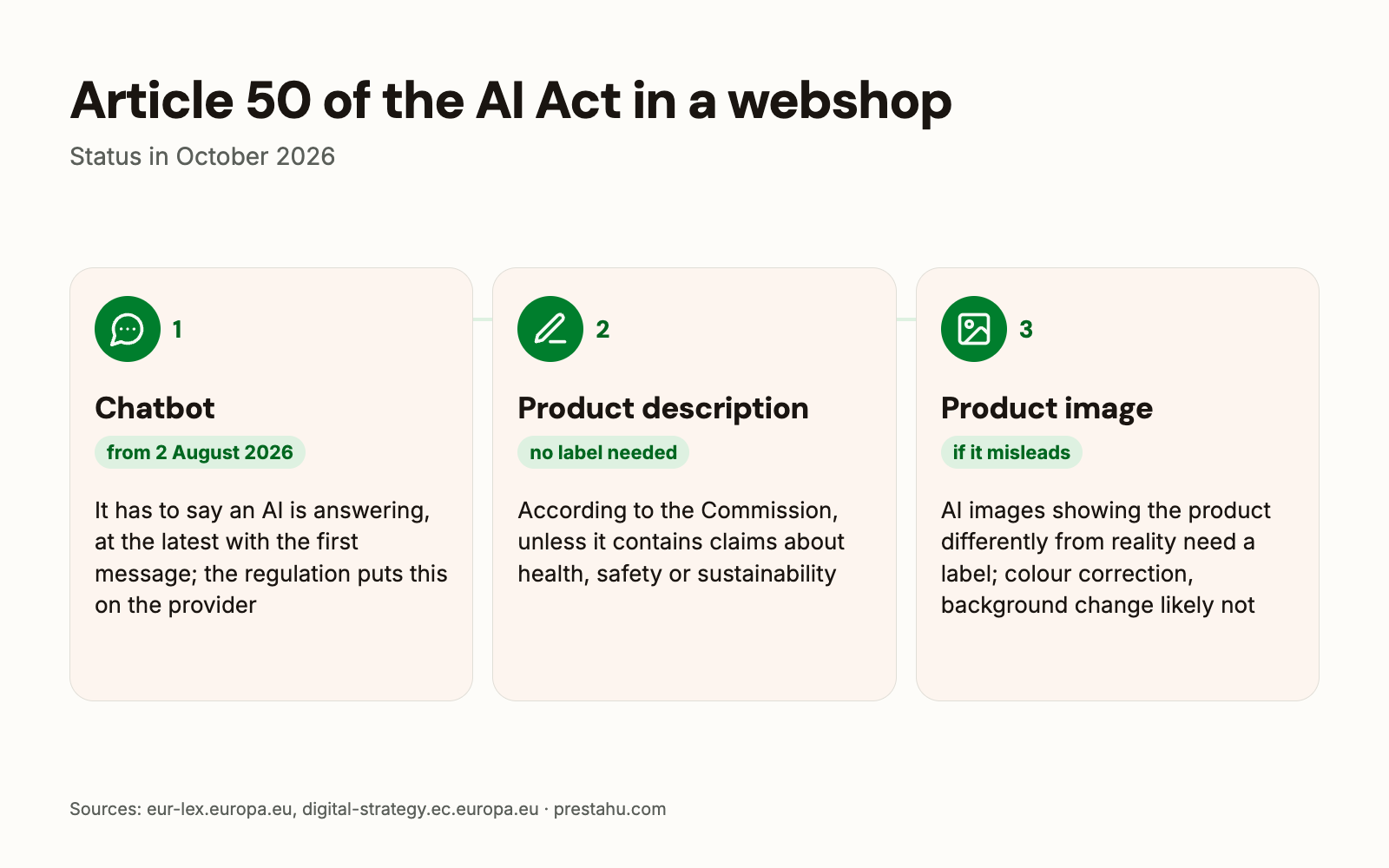
- Product description: according to the Commission, AI-edited text in an advertisement or product description is not "text on matters of public interest", so it needs no label, unless it contains claims related to, for example, health, consumer safety or sustainability.
- Product image: an AI-generated product image is a deep fake if it can mislead about the product's actual appearance or characteristics, for example by making it look more appealing or of better quality. Then a visible label is needed; machine-readable marking is not enough.
- Not a deep fake: a real product in front of an AI-generated background, as long as it does not mislead about the product; according to the Commission, colour correction, aesthetic background replacement and re-scaling likely have only a minor impact.
Content created before 2 August 2026 does not need to be labelled retroactively; the Commission encourages it where possible. Consumer protection rules apply alongside Article 50: misleading about a product's main characteristics is prohibited with or without AI.
How high are the fines, and who enforces the rules?
Breaching Article 50 can lead to a fine of up to €15 million or 3% of the previous year's worldwide turnover, whichever is higher; for small and medium-sized enterprises the lower of the two is the cap. The amount also depends on the gravity and duration of the breach and the size of the business.
According to the Commission, the rules are mainly enforced by national market surveillance authorities; the EU AI Office only has a limited role. Each Member State designates its own authority.
Article 4 of the regulation has applied since 2 February 2025: those who use AI at work should support their staff's AI literacy. Regulation 2026/1744 softened this: no specific level has to be guaranteed.
What does PrestaShop 9.2's Ask AI do?
In the Classic edition of PrestaShop 9.2, released on 30 September 2026, Ask AI is an assistant built into the back office: merchants can ask about their store data and trigger actions in natural language. According to PrestaShop:
- it is available only in the back office, customers do not see it, and it cannot be added to the storefront;
- it is powered by the PrestaShop MCP Server; the merchant chooses a provider (for example OpenAI, Anthropic, Google, Mistral) and enters their own API key;
- it has to be set up before use (MCP Server and MCP Tools modules, PrestaShop Account, webservice, provider and key); it does not work in maintenance mode;
- it asks for approval before changes (orders, products) and runs queries without approval; conversations are kept for 30 days.
Those who use Ask AI to run the shop are also covered by the AI literacy rule of Article 4.
How does this work with PrestaShop modules?
The PrestaHU AI chat assistant module adds a chat window to the shop:
- visitors ask in their own words, and artificial intelligence answers from the shop's products, texts and settings;
- a recommended product appears in the chat as a card with image, price and link;
- quick questions and rules that the assistant follows in every answer;
- consent or an e-mail address before the first message, message and conversation limits, opening hours;
- if the assistant cannot help, the visitor can continue with a person on WhatsApp with one button;
- conversations and orders placed after a chat are listed in the back office; it runs with an OpenAI (ChatGPT) API key.
AI search tools (ChatGPT, Gemini, Perplexity) read the text of web pages. The PrestaHU llms.txt generator module builds a tidy list (llms.txt) of the shop's categories, products with prices and information pages, refreshes it on a schedule, per shop and language; each AI crawler can be allowed or blocked separately. This is not an AI Act obligation; it helps the shop's visibility.
What should you do now?
- Chatbot: check as a visitor whether the chatbot says, at the latest with the first message, that an AI is answering (label, first message or a badge near the input field).
- Product images: go through AI-generated or AI-edited images; where they show the product differently from reality, label them or replace them with real photos.
- Product descriptions: have a person check AI-written claims about health, safety or the environment, and have someone take responsibility for them.
- Staff: briefly agree who uses which AI tool to run the shop, and what to watch out for.
AI chat assistant for PrestaShop
A chat window that answers from the shop's products and texts, with product cards, rules, a consent request and WhatsApp handover.
Frequently asked questions
From when does a shop chatbot have to say it is an AI?
Article 50 of the AI Act has applied since 2 August 2026; the information is due at the latest at the first interaction. Regulation 2026/1744 did not postpone this.
Do AI-written product descriptions need a label?
According to the Commission's guidelines, no, unless they contain claims related to health, consumer safety or sustainability.
Do AI-generated product images need a label?
Yes, if they can mislead about the product's actual appearance or characteristics. According to the Commission, colour correction or an aesthetic background change is likely not such a case.
How high is the fine?
Up to €15 million or 3% of worldwide turnover; for small and medium-sized enterprises the lower of the two. National market surveillance authorities enforce the rules.
Can customers see PrestaShop's Ask AI?
No. According to PrestaShop, Ask AI is available only in the back office and cannot be added to the storefront.
Sources: Regulation (EU) 2024/1689, Regulation (EU) 2026/1744, European Commission: Article 50 guidelines, European Commission: FAQ, Code of practice, PrestaShop 9.2, PrestaShop Help Center: Ask AI


Comments
No comments yet.