


Since 1 January 2025, online stores established in Romania have had to report their invoices to consumers through RO e-Factura, Romania's national e-invoicing system, and since 1 January 2026 within 5 working days. A planned extension to private individuals who invoice under their personal identification number (CNP) was cancelled before it started: Law no. 88/2026 removed that obligation from 1 June 2026.
This article sums up who has to report consumer (B2C) invoices, what goes in the customer's tax ID field, the deadline and fines, and what an online store established outside Romania should check when it sells to Romanian consumers. The official documents are available in Romanian only; the English terms below are our own translation.
Not a technical person?In plain English: do I need to do anything now?
If the online store is a business established in Romania, every invoice to a private customer has to reach the e-Factura system within 5 working days. The customer still gets the usual invoice; sending it to the tax authority is a report.
If the store is established in another country and has no seat or fixed establishment in Romania, the Romanian B2C rule names only sellers established in Romania. With a warehouse or a team in Romania, it is worth having an accountant review the setup.
If an accountant or an invoicing service handles the invoices, the question below can be sent to them as it is.
Question for the accountant or the invoicing service
We sell online to private customers in Romania. Are we considered established in Romania for RO e-Factura? If yes, do our consumer invoices reach e-Factura within 5 working days, and what goes in the customer's tax ID field when the customer gives no CNP?
Who has to report consumer invoices in RO e-Factura?
Under Romanian law (Government Emergency Ordinance no. 120/2021), a B2C transaction is one between a taxable person established in Romania and a non-taxable person, such as a private customer. According to the Romanian tax authority (ANAF), a business is established in Romania if its seat of economic activity is there, or if it has a fixed establishment there with enough staff and technical resources to make sales regularly.
| What | Since |
|---|---|
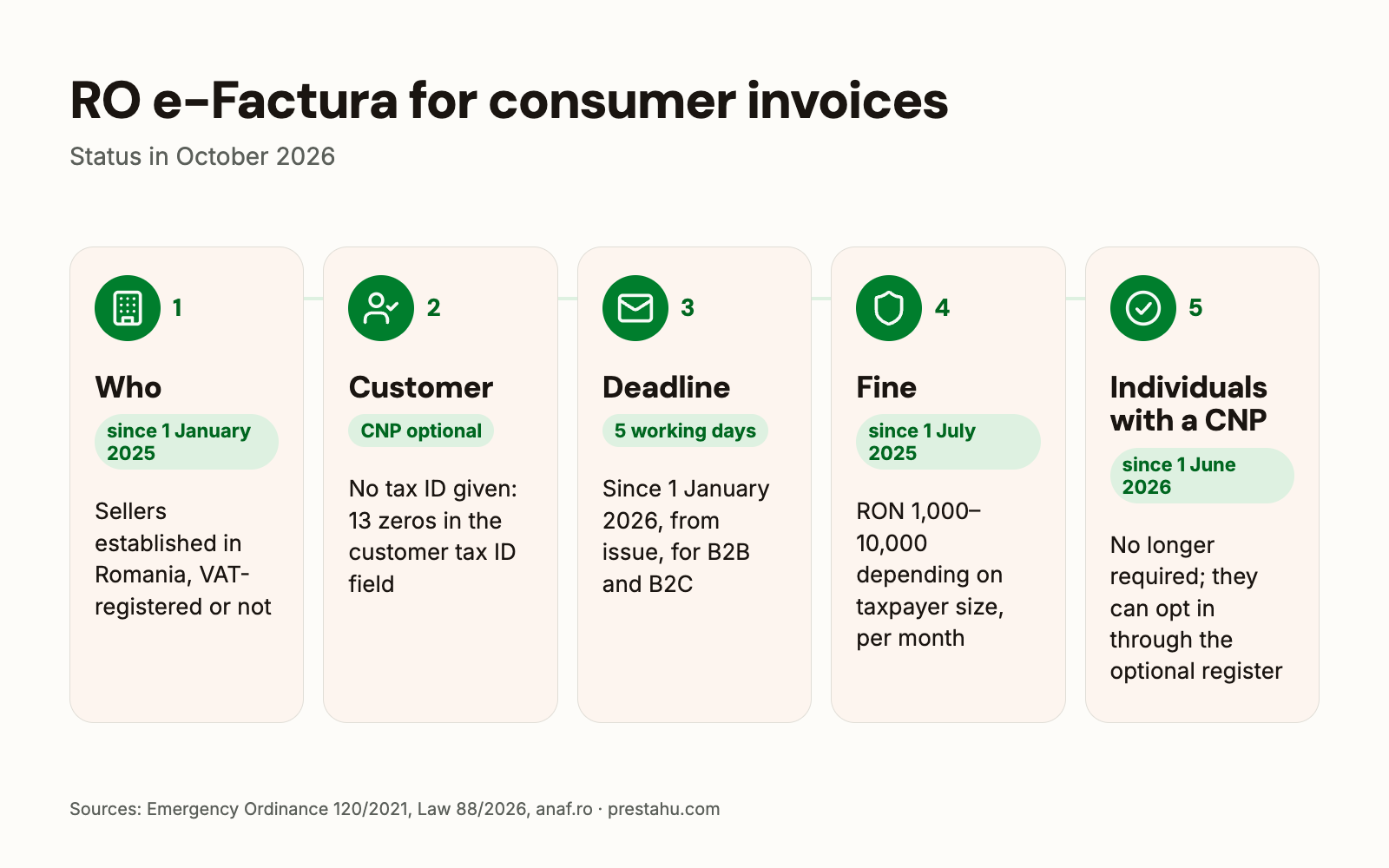
| sellers established in Romania must report their B2C invoices, whether or not they are VAT-registered | 1 January 2025 |
| deadline of 5 working days, for B2B and B2C invoices | 1 January 2026 |
| private individuals who invoice under their CNP are not required to use e-Factura | 1 June 2026 |
The customer still receives the usual invoice under the Romanian Tax Code (article 319); sending it to the system is a report.
What goes in the customer's tax ID field?
A private customer can choose whether to give their CNP. If the customer gives no tax identification code, the invoice is issued with a code of 13 zeros in place of the customer's tax ID. Asking for the CNP at checkout is therefore not required.
What are the deadline and the fines?
Since 1 January 2026, an invoice has to be sent within 5 working days of issue, and no later than 5 working days after the deadline for issuing it under the Tax Code. The fine for not reporting B2C invoices, under Emergency Ordinance no. 120/2021:
- large taxpayers: RON 5,000–10,000;
- medium taxpayers: RON 2,500–5,000;
- other legal entities and private individuals: RON 1,000–2,500.
Does the rule apply to an online store outside Romania?
The legal text names sellers established in Romania; it does not name other sellers. Businesses not established in Romania can choose to use e-Factura for B2B or B2G sales, through the optional register.
Under the Romanian Tax Code, a seller that uses one of the special schemes (including the EU distance-selling scheme known as OSS) follows the invoicing rules of the member state where it is registered. So if the store has no seat or fixed establishment in Romania and accounts for VAT through OSS, invoicing follows the rules of its country of registration.
No ANAF document states in so many words that a foreign OSS seller is exempt. A store with a warehouse, staff or a Romanian VAT registration in Romania should have an accountant check whether it counts as established there.
What happened to the extension to private individuals?
Emergency Ordinance no. 89/2025 required suppliers who identify themselves for tax purposes by their CNP to use e-Factura from 15 January 2026, and Ordinance no. 6/2026 postponed this to 1 June 2026. Law no. 88/2026, published on 29 May 2026, provides that from 1 June 2026 these suppliers are not required to apply the e-Factura rules; they can choose to use the system. The rule for online stores established in Romania did not change.
How does this work with PrestaShop modules?
PrestaShop does not send invoices to e-Factura on its own. Usually the store's order goes to an invoicing service, which issues the invoice and sends it to the tax authority. Romanian invoicing services such as SmartBill, Oblio, FGO and factureaza.ro offer, according to their own pages, a PrestaShop connection and e-Factura submission. Before relying on one, it is worth checking on a test order what ends up in the customer's tax ID field and when the invoice reaches e-Factura.
What should you do now?
- Establishment: check whether the store counts as established in Romania (seat or fixed establishment there).
- Deadline: if it does, check that B2C invoices reach e-Factura within 5 working days.
- Customer data: the CNP is optional for the customer; without it, the invoice goes with 13 zeros.
- Connection: check on a test order that the invoice is issued and sent without a manual step.
Frequently asked questions
Is RO e-Factura mandatory for invoices to consumers?
Yes, since 1 January 2025, for sellers established in Romania, whether or not they are VAT-registered.
Does a store outside Romania have to use RO e-Factura for Romanian consumers?
The legal text names sellers established in Romania. A seller using OSS follows the invoicing rules of its country of registration. With a seat or fixed establishment in Romania, an accountant should check the setup.
Does the customer have to give their CNP?
No. If the customer gives no tax ID, the invoice is issued with a code of 13 zeros.
What is the deadline?
Since 1 January 2026, 5 working days from issue, and no later than 5 working days after the invoicing deadline.
Did e-Factura extend to private individuals on 1 June 2026?
No. Law no. 88/2026 provides that from 1 June 2026, suppliers who identify themselves by their CNP are not required to use e-Factura.
Sources (in Romanian): Emergency Ordinance no. 69/2024, ANAF: changes made by Emergency Ordinance no. 138/2024, Emergency Ordinance no. 89/2025, Ordinance no. 6/2026, Law no. 88/2026, ANAF: Electronic invoicing, ANAF: tax changes in 2026, Romanian Tax Code, SmartBill, Oblio, FGO, factureaza.ro


Comments
No comments yet.