

A growing share of shopping journeys no longer starts on a results page. People ask ChatGPT, Gemini or Perplexity where to buy something, and act on the answer. The question every shop owner then has is what has to be configured for this, and whether anything has to be configured at all.
The short answer is that there is no separate AI optimisation, but three things decide whether a shop can even be mentioned in such an answer: whether the assistant is allowed to reach the pages, whether the data it finds is current, and whether a product feed is ready for the platforms that open a checkout of their own. This article goes through what Google's and OpenAI's own documentation says about each, and what is worth checking today.
Not a technical person?The short version: what makes a shop visible to AI?
AI assistants do not pick from a list of their own. They read the same pages search engines read, and they tell the person what they found there. If the pages of a shop are reachable and current, the shop can come up in an answer. If something keeps the reading programs out, it cannot.
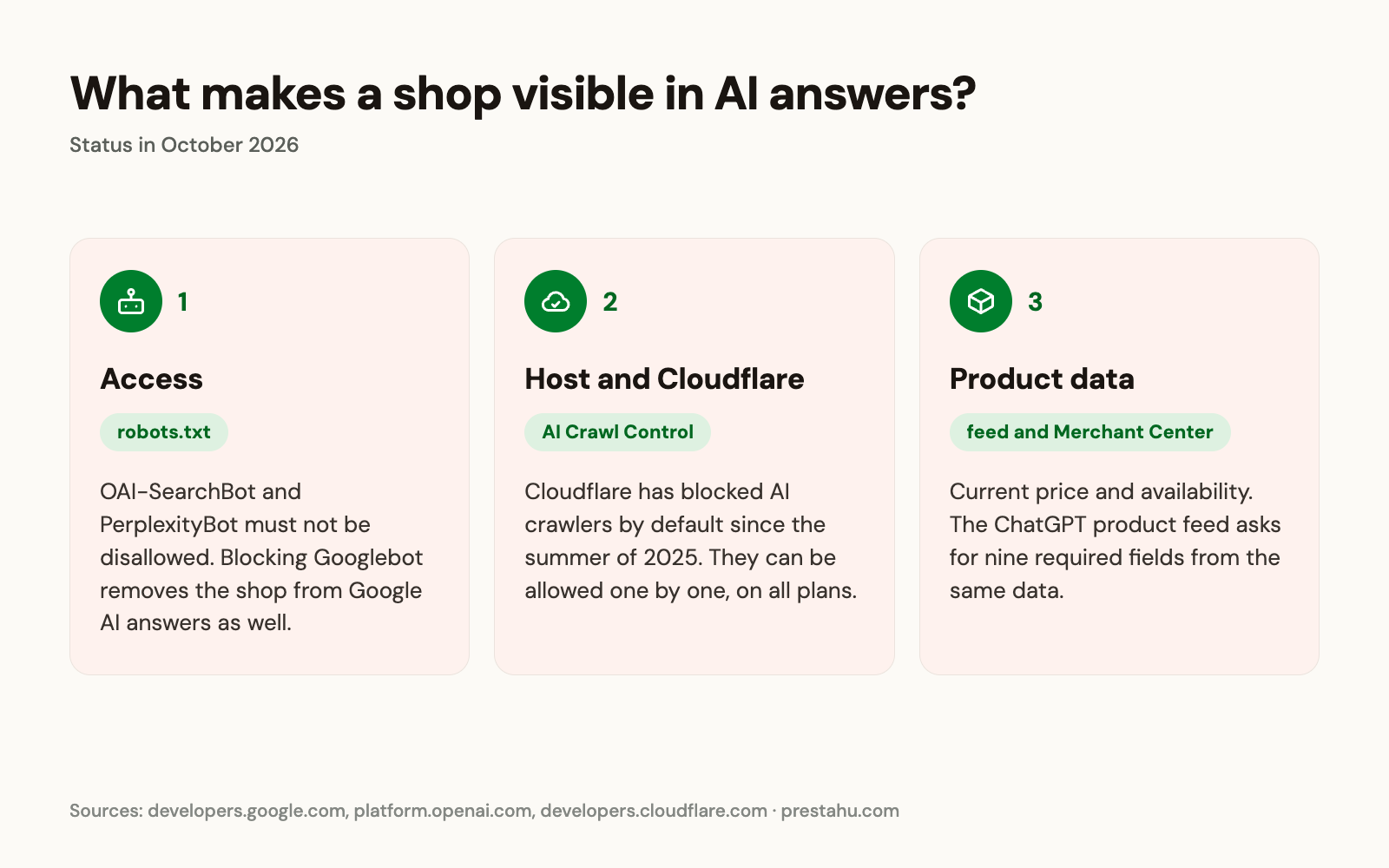
There are two places where they get shut out by accident: the robots.txt file of the shop, and the protection settings of the hosting provider or Cloudflare. The second is the more common one, because in the summer of 2025 Cloudflare made blocking AI crawlers the default.
So the thing to do is not to produce new files, but to check that nothing is blocking. The shop's developer and the hosting provider can answer that.
Questions for your developer and your host
Does the robots.txt of the shop disallow OAI-SearchBot or PerplexityBot? Is there any rule on the hosting account or in Cloudflare that blocks AI crawlers (AI Crawl Control, bot fight mode, a WAF rule)? If so, which crawlers does it cover, and since when? Is the product data in Google Merchant Center current, in particular price and availability?
Is separate optimisation needed for Google's AI answers?
No. Google's developer documentation states it outright: there are no additional requirements for a page to appear in AI Overviews or AI Mode, and no special optimisations are necessary. The same page adds that you do not need to create new machine readable files, AI text files or markup for this, and that there is no special schema.org structured data to add because of it.
What is a condition instead: the page has to be indexed, and eligible to be shown with a snippet in Google Search. Beyond that, Google lists practices that are already familiar, among them keeping structured data in line with the text visible on the page, and keeping Merchant Center information up to date.
The reverse also holds, and it matters more: whatever keeps a page out of Search keeps it out of the AI answers too. Google says the robots.txt directives for Googlebot are the control for access, while what is shown from the page is bounded by the nosnippet, data-nosnippet, max-snippet and noindex controls. A nosnippet added out of caution therefore cuts the shop out of AI answers as well.
Which crawlers should be let in?
In robots.txt, only what is explicitly disallowed counts; anything the file does not mention is allowed. It is still worth knowing what each crawler is for, because not all of them have anything to do with being shown.
| Crawler | What it serves | What a block means |
|---|---|---|
| OAI-SearchBot (OpenAI) | ChatGPT search answers | the shop is not shown in ChatGPT search answers |
| GPTBot (OpenAI) | model training | the content is kept out of training; being shown in search is unaffected |
| ChatGPT-User (OpenAI) | opens a page because a user asked for it | robots.txt rules may not apply, because the visit is initiated by a person |
| PerplexityBot | being surfaced and linked in Perplexity | the shop is not shown in Perplexity answers |
| Googlebot | Google Search and its AI answers | the shop drops out of Search and of the AI answers with it |
| Google-Extended | training and grounding of the Gemini models | according to Google it does not affect inclusion in Search and is not a ranking signal |
OpenAI's documentation states that the settings are independent of each other: OAI-SearchBot can be allowed for the sake of search visibility while GPTBot stays disallowed. After the file is edited, it takes around a day for ChatGPT search to pick the change up.
Could the host or Cloudflare be blocking AI crawlers?
This is the more common cause, and it is not decided inside the shop. On 1 July 2025 Cloudflare announced that it was changing the default to block AI crawlers unless they pay for the content. The feature is called AI Crawl Control, it is available on all plans, it shows how much each AI crawler is requesting, and it allows or blocks them one by one. Paid access, pay per crawl, is in private beta for now.
In practice this means the robots.txt of the shop can allow everything while the request never reaches the shop at all, because Cloudflare answered first. A robots.txt entry is a request; a Cloudflare rule is enforcement, which is why the two have to be checked separately. A firewall or bot protection at the hosting provider can filter the same way, and there the block is often caused by a general rule rather than by the name of an AI crawler.
If the shop sits behind Cloudflare, the AI Crawl Control screen shows row by row which crawler was blocked. That doubles as the measurement: a crawler that does not appear on the list never tried.
How do products get into ChatGPT shopping answers?
At this point a readable page is no longer enough. OpenAI asks for a separate product feed, and its documentation says that onboarding product feeds in ChatGPT is currently available to approved partners, by application. So when something claims that a shop can simply be plugged into ChatGPT, it is worth knowing that this is not self-service onboarding.
The structure of the feed is public, though, and it is worth preparing for, because it is built from the same data Google Shopping asks for. Nine fields are required: item_id, title, description, url, brand, seller_name, image_url, availability and price. The recommended rhythm is one full feed a day as a file upload, with changes during the day sent through the API; promotions data can only be provided via the API.
Payment stays with the merchant. According to OpenAI's documentation the checkout state and the payment processing happen on the merchant's systems, and OpenAI is not the merchant of record. A shop hands over no part of the transaction, it only becomes reachable on one more surface.
Which means that for a shop whose Google Shopping feed is not in order, that feed is the next step, not AI. The same data, the same defects: missing brand, stale price, wrong availability. Our Product feed export module builds the Google, Facebook and TikTok feeds from one source, and our article on the Merchant API covers what changed on Google's side this year.
Does a shop need an llms.txt file?
Not in order to be shown. The Google documentation quoted above explicitly says there is no need to create AI text files, and no search engine or assistant documents one as a condition. Large documentation sites, among them the developer sites of OpenAI and Cloudflare, do publish such a file, because it makes their own documentation easier to read with an AI tool, but that is not a ranking or eligibility factor.
What it does help with is different: the file gives an ordered list of what the shop holds, which makes it more predictable what a reading program finds. For anyone who would rather not maintain that list by hand, our llms.txt generator module keeps it in step with the products, categories and information pages. The order cannot be reversed, though: if the crawlers are shut out or the data is stale, this file will not help.
How can traffic from AI answers be measured?
Clicks from Google's AI answers appear in the Search Console performance report, within the "Web" search type, together with the rest of the search clicks. There is no separate AI row, so Search Console cannot tell you how many of them came from there.
The other route is your own analytics: visitors arriving from AI surfaces carry the referrer of that surface, for example chatgpt.com or perplexity.ai. It is worth setting up a segment or a report for these in Google Analytics 4, because by default they dissolve into general referral traffic. On the advertising side, our ChatGPT Ads module measures the results of ads running in ChatGPT, from the browser and from the server.
One thing not worth doing is quoting an estimated share of orders coming from AI answers. There is no data today that a shop could read off its own surfaces to support such a number.
What is worth doing now?
- Open
robots.txton the shop's own address (/robots.txt) and look forOAI-SearchBot,GPTBot,PerplexityBotandGoogle-Extended. If none of them has aDisallow, this part is in order. - Ask the host, or check Cloudflare, whether any rule blocks AI crawlers. On Cloudflare the AI Crawl Control screen shows it crawler by crawler.
- Check indexing in Search Console, because a page that is not indexed cannot appear in an AI answer either. A
nosnippetleft in place by mistake belongs here too. - Get the product feed in order (price, availability, brand, image), because the same data serves Google Shopping and a ChatGPT feed alike.
- Set up the measurement in Google Analytics 4 for referrals from AI surfaces, so that there is a baseline to compare against in the coming months.
Everything beyond that is content work, and it is the same work search optimisation has always asked for: accurate product names, real descriptions, filled-in attributes, structured data that matches the page. No new technique is needed for it.
Frequently asked questions
If I disallow GPTBot, do I disappear from ChatGPT answers?
No. OpenAI's documentation states that the settings are independent: GPTBot collects for training, while search visibility is handled by OAI-SearchBot. Disallowing the latter is what removes a site from ChatGPT search answers.
Should schema.org markup be added because of AI?
Google says there is no special structured data to add for this. For existing product markup the condition is that it matches the text visible on the page.
Can my products be bought inside ChatGPT today?
Onboarding a product feed is, according to OpenAI's documentation, currently available to approved partners by application. Payment happens on the merchant's systems, and OpenAI is not the merchant of record.
How do I know whether an AI crawler has visited at all?
From the access log of the hosting account, searching for the crawler's name, or from the AI Crawl Control list on Cloudflare. A crawler that appears nowhere never tried.
Sources: Google Search: AI features and your website, Google: Common crawlers (Google-Extended), OpenAI: Bots, OpenAI Commerce: Get started, OpenAI Commerce: product feed specification, OpenAI Commerce: key concepts, Perplexity: Bots, Cloudflare: Content Independence Day, Cloudflare: AI Crawl Control

Comments
No comments yet.