




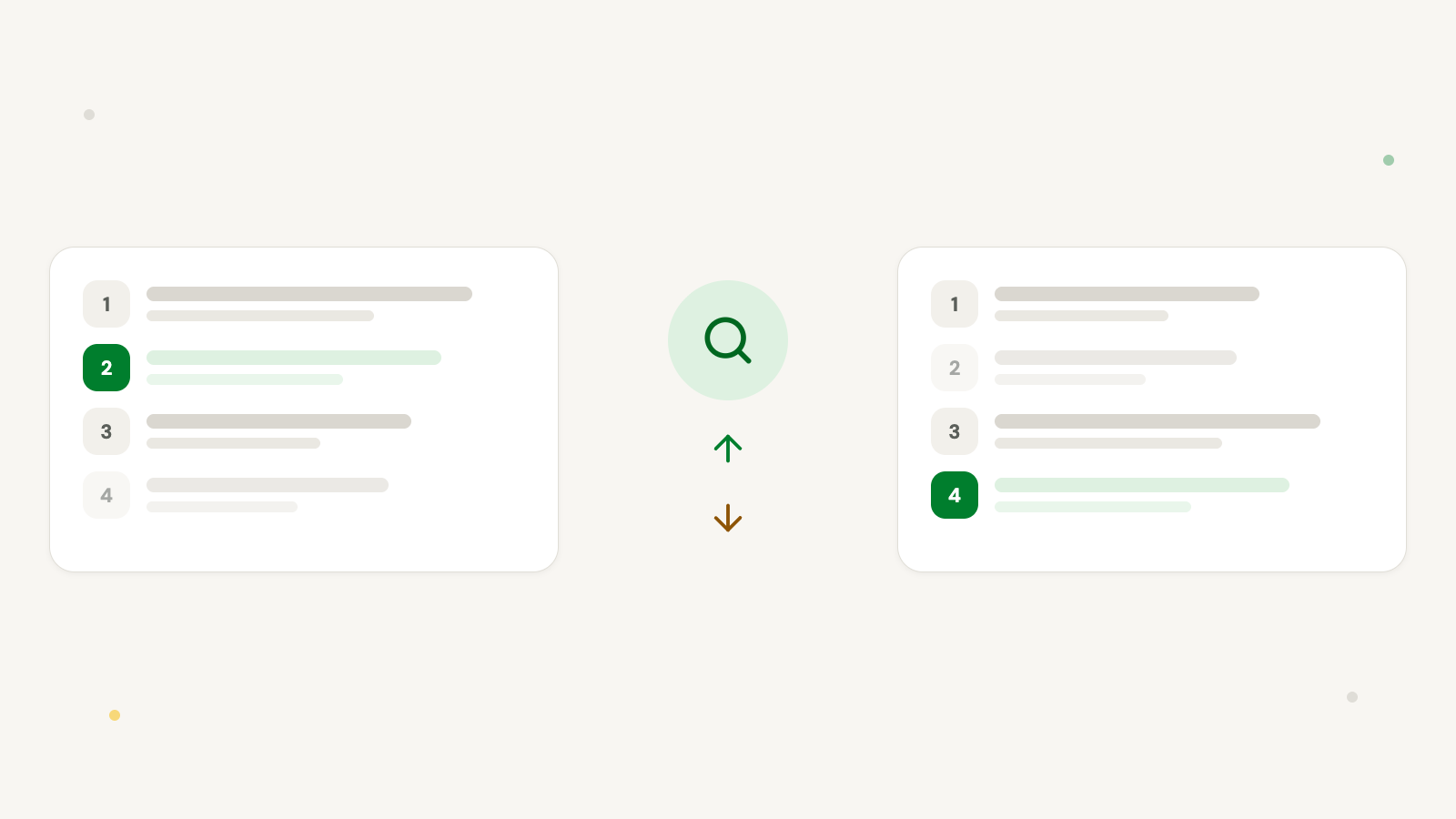
On 10 November 2026 Google released the November 2026 core update, a broad change to how search results are ranked. Its own status page says the update applies globally and to all languages, and that the rollout may take up to two weeks to complete. It is the third core update of the year, after the ones in March and May.
For an online shop this matters wherever buyers arrive from search. Product and category pages can move up as well as down, and the movement settles gradually over the days of the rollout rather than overnight. The timing is awkward, because those two weeks land right before Black Friday, when traffic swings anyway.
Not a technical readerThe short version: what this means for the shop
Every so often Google reassesses which pages it considers most useful for a given search. When that happens, the order of your own pages can change even though nothing happened in the shop.
A change like this is not a penalty and not a fault. Google's own documentation states that these updates do not target specific sites or individual pages; they re-measure ranking as a whole.
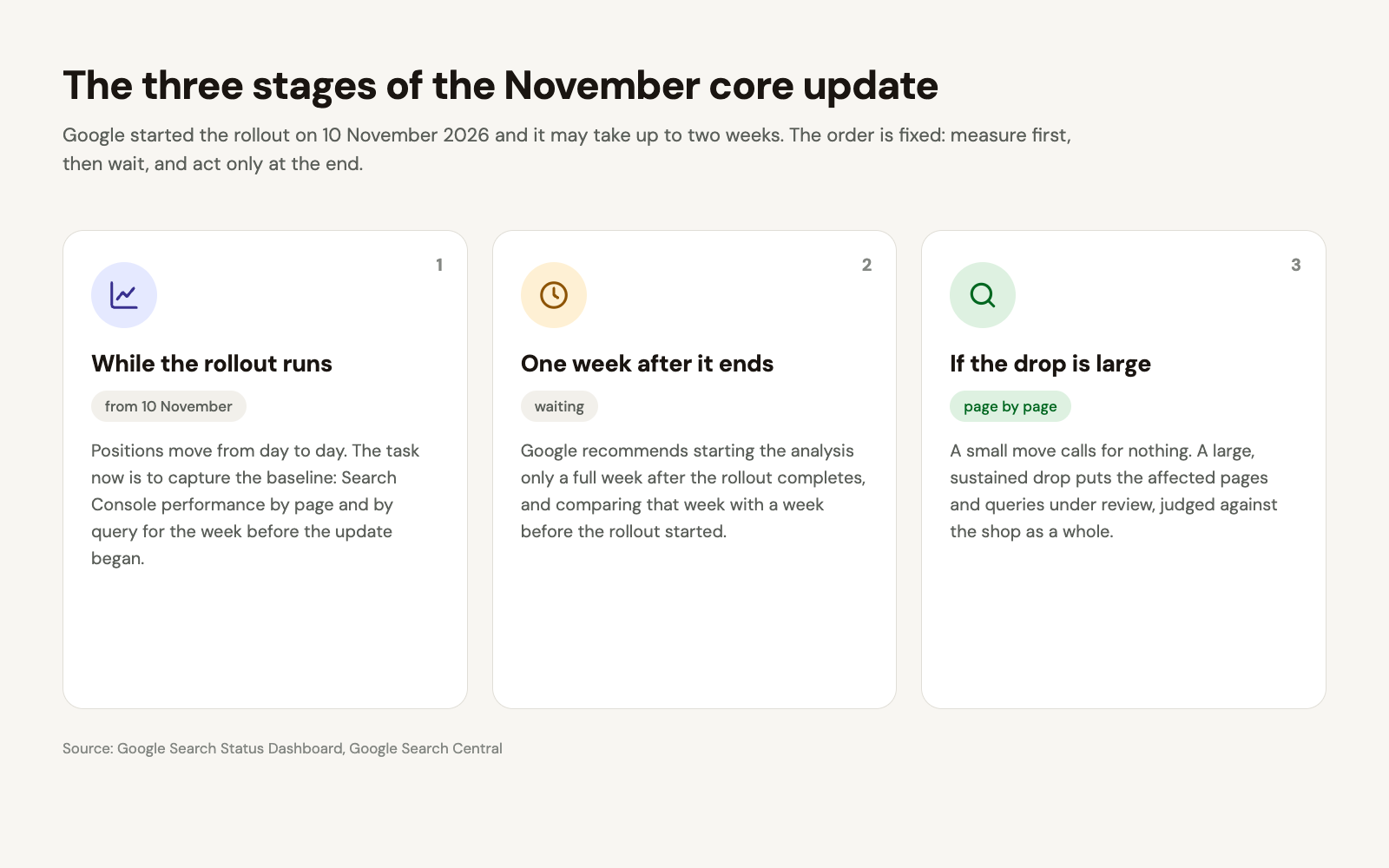
What to do right now is wait. Google recommends waiting at least a full week after the rollout finishes before comparing any data. Rewriting pages in a hurry during these days tends to cost more than it gains.
Questions for whoever maintains the shop
Google's November core update has started rolling out. Please export the Search Console performance data for the week before it began, by page and by query, so we have a baseline to compare against later. Until the rollout is confirmed finished, let us hold back any larger content or structural change on product and category pages. One week after it finishes, I would like a comparison: which pages lost meaningful traffic, and on which queries.
What happened on 10 November?
Google posted on the Search Status Dashboard that it had released the November 2026 core update. According to that entry the update applies globally and to all languages, and the rollout may take up to two weeks. The incident began at 10:06 US Pacific time.
A core update is not a spam update and not a sanction. Google describes these broader changes as ones that are not aimed at specific sites or individual pages: they reassess which results are the most helpful for a query as content across the web keeps changing.
The end of the rollout appears on the same status entry as the start. The two earlier core updates of 2026 took 12 and 11 days, so "up to two weeks" is an upper bound rather than a schedule.
How long does it run, and how do you know it is over?
The update runs until a completion date shows up on the status dashboard. Until then positions can shift from one day to the next, and a Tuesday reading will look different on Wednesday. A drop or a rise measured mid-rollout is a snapshot, not a result.
What is useful now is capturing the starting point. In Search Console, the week before the rollout began, broken down by page and by query, becomes the basis of every later comparison. Export it now and you will not be working from memory in two weeks' time.
Why rewriting pages in a hurry is a poor idea
Google is unusually direct here: it recommends against changing content that is already performing well, and against "quick fix" edits made because something was said to be bad for SEO. Its documentation treats deleting content as a last resort, for pages that genuinely cannot be salvaged.
There is a practical reason too. If a product description, a category text or the page structure changes mid-rollout, nobody will be able to tell afterwards what moved the position: Google's update or your own edit. A month later, answering that question costs twice the work.
What can go ahead without hesitation is fixing faults. A page that fails to load, slow rendering, a broken redirect, a missing product attribute: none of that is SEO tuning, it is operations, and it is due before Black Friday anyway.
When should you compare data in Search Console?
Google's own sequence has four steps, and the order matters:
- Confirm the rollout has finished on the status dashboard, and note the start and end dates.
- Wait at least a full week after completion before starting any analysis.
- Compare the week after completion with a week before the rollout started, not with some arbitrary period.
- Review your top pages and queries separately, and check which surface the movement happened on: web, images or video.
The rollout began on 10 November, so if it uses the full two weeks, the earliest meaningful comparison falls in early December. Drawing conclusions sooner works against Google's own guidance.
A small drop or a large drop: where is the line?
Google separates the two cases. After a small move, from position two to four for example, the documentation explicitly advises against drastic action. A large drop, from position four to twenty-nine, is what warrants a deeper assessment.
That deeper assessment is about the shop as a whole rather than one detail on one page. Google's self-assessment questions ask whether the content carries original information, whether it covers the topic fully, whether expertise is visible behind it, and whether it is the kind of page a reader would bookmark or share. Translated to a shop, that is a question about product descriptions and category texts: is there anything in them that did not come off the manufacturer's data sheet?
What does this mean before Black Friday?
If the rollout uses its full window, it runs to around 24 November and finishes in the opening days of Black Friday week. Two things follow. Search traffic measured during the season will not be comparable with last year's, because two effects are mixed into it. And paid channels and email carry more weight over these two weeks, because what they deliver does not move with the ranking.
So the useful work for a shop preparing for the season sits in the order flow and on the advertising side: a checkout that works, correct delivery dates, live measurement. Sorting out rankings comes in early December, on the basis of data.
If the drop really is large, what then?
The first step is to break the measurement down by page: which pages lost ground, on which queries, and how much traffic they carried before. The shop's own traffic figures are available in the reports of the PrestaShop statistics module, together with landing pages and conversions, which shows whether the drop touched pages that actually produced orders.
If the review leads to merging or retiring pages, the old addresses cannot be left without an answer: each one gets a 301 redirect to its successor. The Redirect Manager keeps a register of those and flags broken outgoing links as well.
Reworking the content itself comes after that, and it is writing work: sizing, compatibility, use in practice and the questions buyers actually ask are what the manufacturer's sheet does not contain. Where the work also needs a developer's hand (templates, structure, internal linking), an hour of PrestaShop development can be booked for it.
What is worth doing now?
- Export the baseline from Search Console: performance for 3 to 9 November, by page and by query.
- Pause larger content changes on product and category pages until the rollout is confirmed finished.
- Fix faults regardless: pages that fail, slow loading, broken redirects, missing product data.
- Watch the status dashboard and note the completion date.
- Compare one week after completion, page by page and query by query, against the week before the start.
- Touch the content only after a large, sustained drop, and then within the affected pages, judged against the shop as a whole.
Frequently asked questions
[faq]
Q: How do I know the rollout has finished?
A: On Google's Search Status Dashboard, where the start was published. The completion date appears as part of the same entry.
Q: Does the update affect every shop?
A: It applies to every country and language, but Google states that most sites do not need to worry about core updates and may not even notice one. How much it matters depends on how much of your traffic comes from search.
Q: If positions dropped, will they come back on their own?
A: There is no guarantee. Google says improvements can take effect within days, but it may also take several months, or wait for a later update.
Q: Can I publish a new product or blog post right now?
A: Yes. The advice to hold back concerns rewriting pages that perform well and reshuffling structure, not publishing new content.
Q: What should I examine first if traffic fell?
A: Which pages and queries the drop touched, and whether those pages used to produce orders. That is what sets the order of any intervention, not general SEO advice.
Sources: Google Search Status Dashboard: November 2026 core update, Google Search Central: core updates and your website, Google Search Central: creating helpful, reliable content