



On 11 November 2026 the European Commission put forward its proposal for the Digital Fairness Act (DFA). The proposal takes aim at manipulative interface design, hidden fees, subscriptions that are hard to cancel and personalised pricing, and it would turn the Unfair Commercial Practices Directive into a Regulation, applying directly and with the same wording in every Member State.
For an online shop the proposal lands in the places where a customer decides: the stock label on the product page, the items that end up in the basket on their own, the moment the delivery fee becomes visible, and the route out of a mailing list. This is a proposal, not law in force, and the European Parliament and the Council will now negotiate it. Several of the listed practices are, according to the Commission's own summary, already prohibited under today's consumer rules.
Not a technical person?The short version: what is being asked of the shop?
The EU has proposed a new set of rules on how a customer may be moved towards a purchase. The idea behind it is short: what the screen says should be true, and leaving a decision should be as easy as entering it.
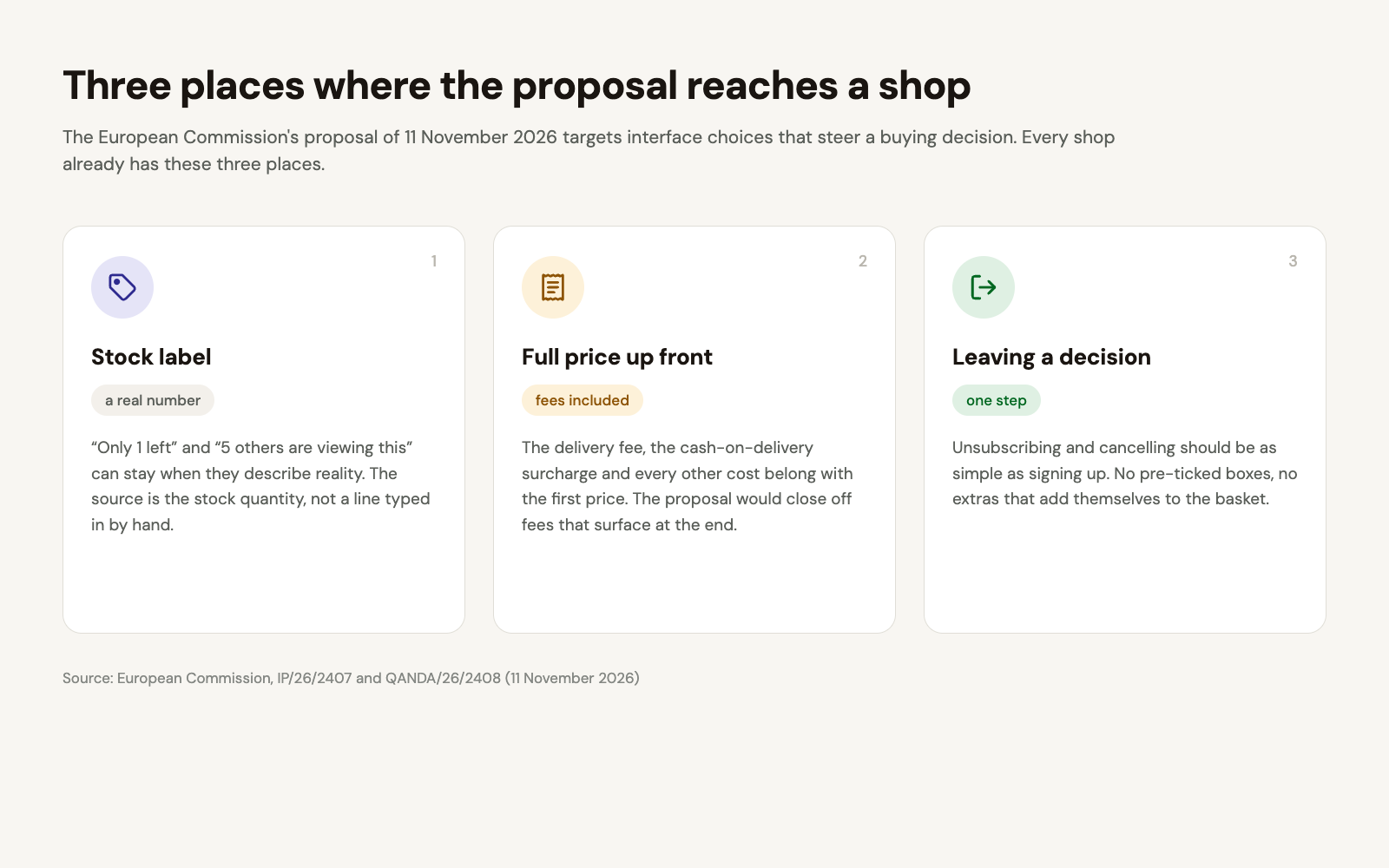
In a shop that touches a handful of specific spots. A label saying “only one left” can stay only if one really is left. The delivery fee and every surcharge should appear with the first price, not at the end of checkout. Pre-ticked boxes and extras that add themselves to the basket go. Unsubscribing and cancelling should take one click, without a guilt trip.
What to do now is a review: walk through the product page, the basket and the checkout, and compare what the screen claims with what is true in the warehouse and in the price. Negotiating the proposal will take years, but these settings can be corrected independently of it.
Request for whoever maintains the shop
Please review the shop for the labels that influence a buying decision. Three things matter: whether the stock and urgency labels on product pages are produced from the real stock figure; whether the delivery fee and every surcharge are already visible in the basket rather than only at the last checkout step; and whether any checkbox or extra item is switched on by default or added to the basket on its own. Please send a list of which module produces each of these labels.
What was presented on 11 November?
The Commission tabled a package. It holds the proposal for the Digital Fairness Act, a Simplification Directive and a revision of the Consumer Protection Cooperation (CPC) Regulation. In its press release the Commission calls this the most significant upgrade of EU consumer protection legislation in over 20 years, and estimates the package will save consumers up to €13.7 billion a year.
From a shop's point of view the structural change matters more than any single prohibition. The proposal would turn the Unfair Commercial Practices Directive into a Regulation. A directive is written into each national legal system separately, so the detail differs from one country to the next; a regulation applies directly, with identical wording everywhere. The Commission argues this on simplification grounds: a shop selling across borders no longer has to follow a different rule in each market.
This is a proposal, not a rule in force. The Commission states that the next step is discussion by the European Parliament and the Council; no date of application is given in the announcement.
Which labels would land on the banned list?
The Commission's questions and answers name what would be added to the list of practices banned in all circumstances. Three groups reach an ordinary shop directly:
- False scarcity — “Only 1 left”, “5 other customers are interested in this”, where the claim does not describe reality.
- Shaming the choice — unsubscribing or cancelling through a button that judges the customer (“I don’t like good deals”), or a route out loaded with guilt.
- Defaults that must be refused — pre-ticked boxes, and extra items added to the basket automatically.
All three are settings rather than development work. In most shops the wording of the label and the default state of a checkbox are edited on the same screen where the product itself is created.
What does showing the full price mean in practice?
The pricing section would close off drip pricing. In the Commission's wording, companies will have to show the full price from the start, including additional fees, taxes and charges. The situation described is the familiar one: a product looks affordable at first because the fees only surface at the end of the booking or checkout process.
In a shop that covers the delivery fee, the cash-on-delivery surcharge, packaging charges and anything else that raises the total. The question is not whether a fee exists, but when the customer sees it: already in the basket, or only at the final step.
The same section deals with dynamic pricing and misleading price comparisons. Showing the lowest price of the previous 30 days before a discount is already required across the EU under the price indication rules; in the shop that record is kept by Omnibus Price History, per product and per shop.
What would change for subscriptions and free trials?
The proposal follows a digital contract through its whole life. According to the Commission's summary a shop would have to offer a simple, unambiguous cancellation option, give clearer information before a free trial ends or a subscription renews automatically, and obtain active confirmation before a trial turns into a paid contract. Customers would also gain a right to reach a human in customer service when a problem arises during an ongoing contract and other routes fail.
This is not only about monthly services. Any shop selling renewable licences, membership fees, recurring bundles or paid trials is in scope. The route to cancellation then becomes as much a part of the interface as the order button.
Handling withdrawal from an order is the neighbouring task: the customer should be able to declare it on the site, and the shop should keep a record of it. That is what Online Withdrawal and Consumer Protection Compliance does: a withdrawal declaration that works from the account and as a guest, with a list, statuses and a confirmation email on the shop side.
Who is affected by the limits on personalised ads and prices?
Today the Digital Services Act stops online platforms from showing personalised advertising to minors and from targeting on sensitive data. The proposal would extend those bans to all websites and apps, an ordinary shop included. It would also prohibit showing higher personalised prices to minors or to vulnerable consumers.
Personalised prices are rare in a typical shop; personalised advertising is almost universal, since the advertising pixel and the remarketing tag send data from the same pages. Consent handling is therefore not merely a cookie question: whether those tags start at all depends on it.
What does this mean for influencer collaborations?
Under the proposal an influencer must clearly disclose being paid to promote a product, and sponsored content may not be presented as personal advice. The sentence that matters from the shop's side is that brands and agencies will have to ensure that the influencer meets those obligations. Disclosure is not left to the creator alone.
The practical consequence sits in the contract: a collaboration agreement should state how the paid nature of the post is shown and who checks that it was.
How large are the fines, and who can the Commission investigate?
The other half of the package is about enforcement. The CPC revision would give the Commission direct powers to investigate and fine, up to 6% of a company's worldwide annual turnover. That figure is not about the daily life of a small shop.
By the Commission's own description it can step in directly when a breach is likely to affect consumers in at least two-thirds of Member States, representing at least two-thirds of the EU population, and when the company involved is not an SME. A case concerning a single shop stays with the national consumer authority, as it does today.
The revision also reaches companies outside the EU: under the proposal they would have to appoint a legal representative in the Union so that authorities can reach them.
What is worth doing now?
- Review the stock and urgency labels on product and category pages: is each one produced from the real stock figure, or is some of it typed in by hand.
- Find the countdowns and the “others are viewing this” labels, and check what data they read.
- Walk through your own checkout with a real order and note when the delivery fee and every surcharge enter the total.
- Go through the checkboxes at registration, at newsletter sign-up and in checkout: none should be pre-ticked.
- Unsubscribe from your own newsletter and count the steps, then read what the button says.
- If you sell anything recurring, write down where and in how many steps it can be cancelled, and whether the customer is told before it renews.
A stock label backed by the real figure
Urgency stays on the right side of the rule when the number is true. Product Badges and Stock Bar builds the badge and the bar from the real PrestaShop stock quantity: the number shown is the stock itself, and the thresholds only decide from which quantity it counts as low.
Frequently asked questions
[faq]
Q: From when do these rules have to be applied?
A: They do not yet apply. The Commission states that the next step is discussion by the European Parliament and the Council, and the announcement gives no date of application.
Q: Will countdown promotions be banned in a shop?
A: The named case is the false claim, where the label does not describe reality. A countdown on a promotion that genuinely ends is not in that group.
Q: Does this reach small shops, or only the large platforms?
A: According to the Commission the Digital Fairness Act would apply to all companies engaging in business-to-consumer practices, not only to online platforms. The Commission's own power to fine would, however, cover only large-scale cases across many Member States and companies that are not SMEs.
Q: What counts as a pre-ticked box?
A: Any choice the customer has to refuse in order not to receive it: a newsletter opt-in switched on, insurance or an add-on selected by default, an item placed in the basket automatically.
Q: Does the delivery fee have to be printed on the product page?
A: The proposal describes showing the full price from the start, fees and taxes included. In practice the basket and the checkout are where the total is formed; the aim is that the customer does not meet the surcharge at the last step.
Sources: European Commission press release (IP/26/2407, 11 November 2026), Questions and answers on the Consumer Package (QANDA/26/2408), European Commission: Digital Fairness Act